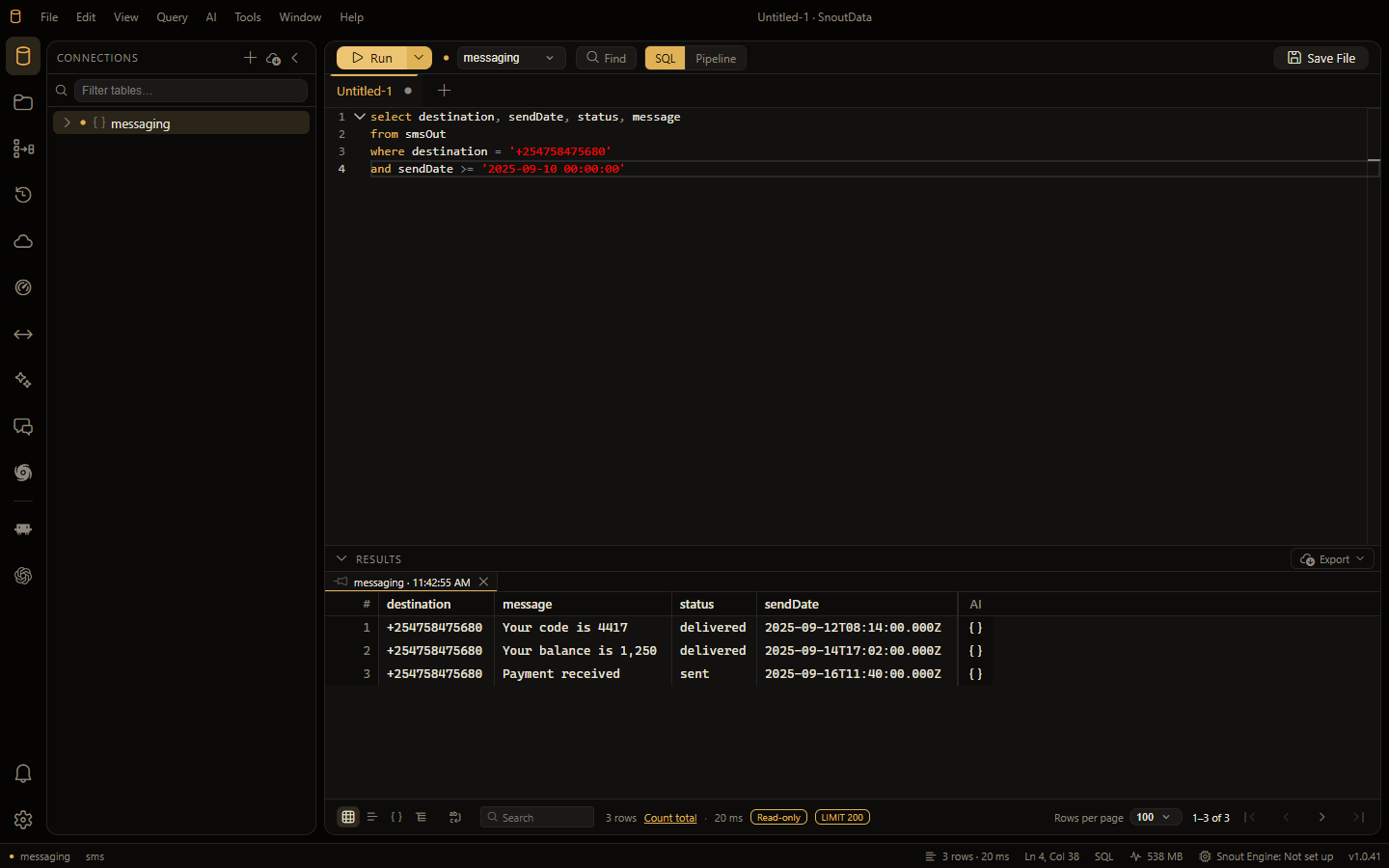
Syntax checks
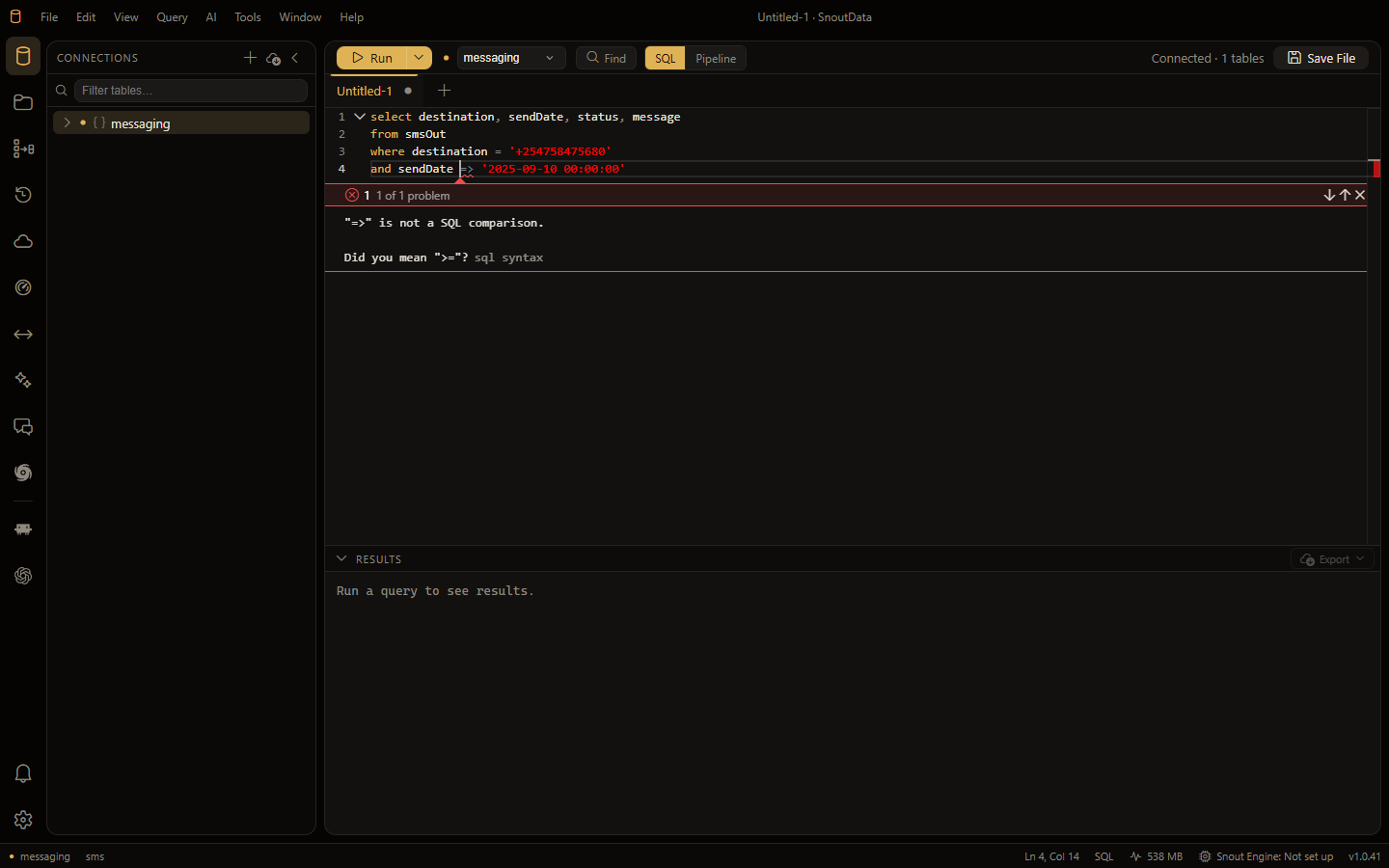
On a MongoDB, vector, or log connection, SnoutData reads your SQL itself and underlines a statement that will not parse, before you run it. Where the mistake is one it recognises, it names the fix.
Why only those connections
On a relational connection your SQL goes to the database, and the database answers in its own dialect: PostgreSQL, MySQL, Oracle and SQL Server each accept things the others reject, and their error messages are the authority. SnoutData does not second-guess them.
A document, vector, or log connection has no such authority. The SQL you write there is compiled
in the app into an aggregation pipeline, a vector query, or a log query, so nothing downstream
will ever tell you that you typed => instead of >=. That is the gap this fills.
None of it calls a model. The check is the same parser the compiler uses, running locally, so it costs nothing and works offline.
What it recognises
Anything that does not parse is underlined with its position. These get a suggested fix as well, because they are near-misses rather than nonsense, mostly habits from another dialect:
| You wrote | What it says |
|---|---|
sendDate => '2025-09-10' | "=>" is not a SQL comparison. Did you mean >=? |
price =< 100 | Did you mean <=? |
status == 'sent' | SQL compares with a single =. |
age !< 18 | Did you mean >=? |
SELECT TOP 10 ... | TOP is SQL Server's. Use LIMIT. |
LIMIT 10, 20 | That is MySQL's two-argument form. Use LIMIT 20 OFFSET 10. |
# a comment | # does not start a comment. Use --. |
SELECT a, FROM t | There is a trailing comma in the list. |
WHERE name = 'ann | A text value is opened with a quote that is never closed. |
A statement you are still typing is not underlined. Half a query fails to parse at every keystroke, so only a mistake the checker recognises is marked while you type; the rest is reported when you run it.
Text in double quotes
WHERE destination = "+254758475680"
This is not a syntax error, which is what makes it worth a warning: in standard SQL a double-quoted name is a column, so the statement runs, compares one field against another field's name, and comes back with nothing. SnoutData marks it and suggests single quotes.
When you run it anyway
Running a statement that does not parse gives you the same message, with its line and column, and nothing else happens: no query is sent, and the AI assistant is not offered. A model cannot translate what does not parse, and being asked to spend AI budget on a typo is worse than being told about the typo.
That is separate from valid SQL the offline compiler cannot represent, which is where the assistant genuinely can help and is offered.