Destinations
Where the data lands. The same flow can be pointed at any of these.
A SQL table
Created for you, or matched to a table you already have, in any relational connection.
You see the exact CREATE TABLE and INSERT statements before anything runs. Writing modes
are append (add the rows) and replace (empty the table first).
A MongoDB collection
Nesting is kept rather than flattened. This is the inverse of what the SQL destination does with a nested record, and it is usually the right answer when the source was already document-shaped.
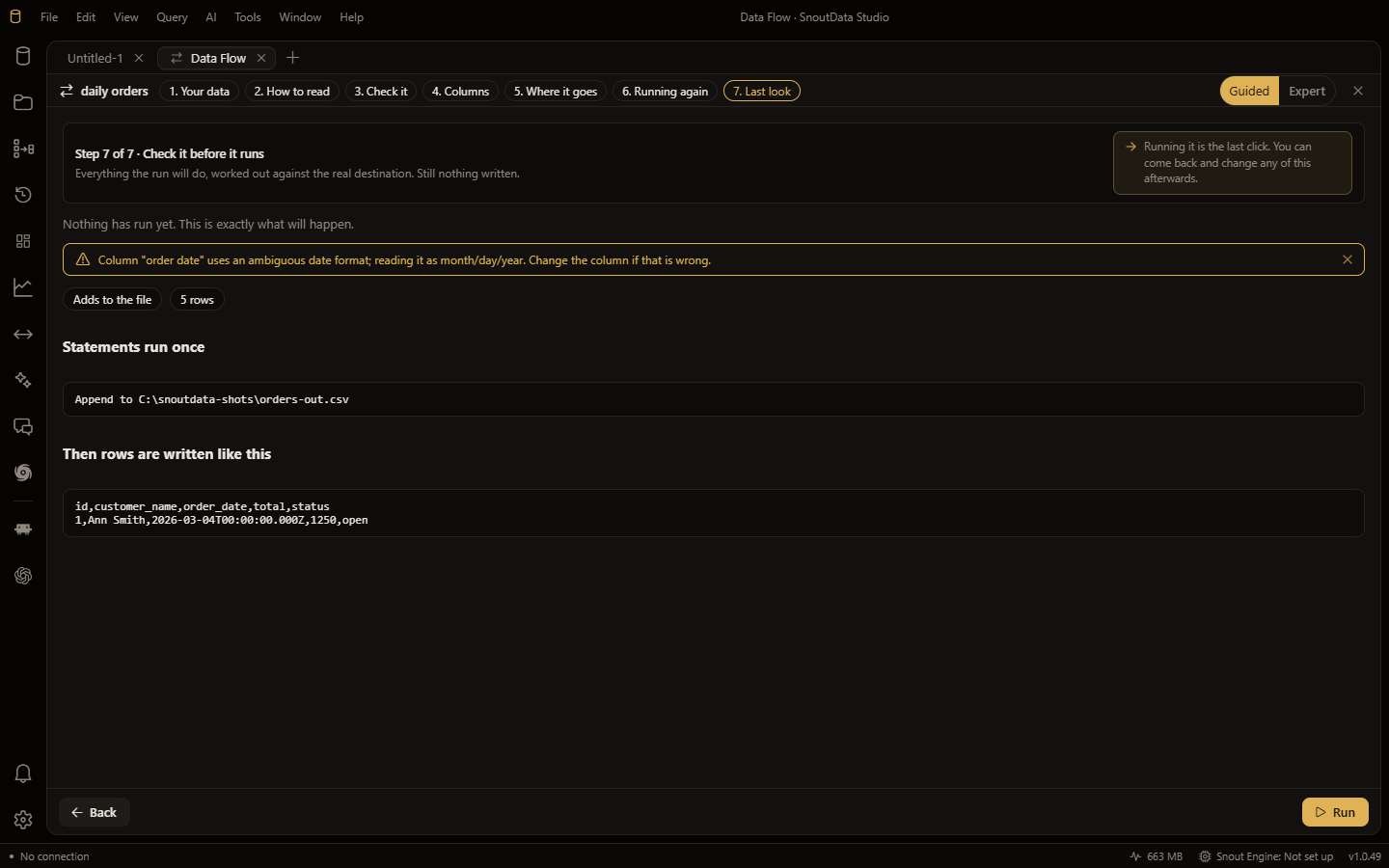
A file
CSV, JSON, JSONL, or a Markdown report you can hand to somebody. Useful when the point of the flow is to produce an artifact rather than to load a database.
A fine-tuning set
Validated JSONL, in the shape a fine-tuning job expects. Together with generation as a source, this makes "produce a dataset and train something smaller on it" one path in one app, rather than two tools and a script in between.
Vectors, for AI search
Each row is split into chunks, embedded, and written with its text and metadata (the file, the page, the section, and the columns you choose), so you can retrieve over what you just brought in. Two places can hold them:
- A vector table in Postgres. Any Postgres with pgvector, including a SnoutData Cloud project.
The flow enables the
vectorextension if it is missing, creates the table and a cosine index, and your app queries it over the connection it already has. - A Pinecone index.
You choose what embeds the text: SnoutData AI, your own Ollama server, or your own OpenAI or
OpenRouter key (the keys saved under Settings, Data Generation). The default model is
mxbai-embed-large. A re-run embeds only the chunks whose text changed, and can remove the
chunks whose source is gone. Change the model and the next run embeds everything again.
To see what the flow built, search it.
Production destinations are guarded
If the destination connection is flagged as production, the same guardrails that protect a query you type by hand apply here: destructive operations are held until you confirm them, and the run is recorded.